SERVOSTAR 620 F16 Fault: Servo Drive Repair and Closed-Loop Testing
When a servo drive arrives for repair, restoring power is only part of the job.
The real question is:
Can the repaired drive correctly control a servo motor again?
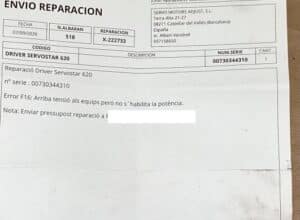
A SERVOSTAR 620 recently arrived at our workshop with an F16 fault. According to the information provided with the unit, supply voltage was reaching the equipment, but the power stage could not be enabled.
This gave us a clear starting point for the diagnosis.
But once the drive was opened, another significant condition became immediately visible.

SERVOSTAR 620 Condition on Arrival
The internal condition of the SERVOSTAR 620 showed a very significant accumulation of contamination.
Deposits were visible across the heatsinks, cooling areas and different sections of the electronic assemblies.
For a servo drive based on power electronics, this type of environment deserves attention. Effective cooling and heat dissipation are important aspects of reliable operation.
However, there is an important distinction to make.
The presence of severe contamination is an observation. It does not, by itself, prove the root cause of the F16 fault.
This is why visual inspection should be combined with electronic diagnosis and functional testing before conclusions are drawn.

Equipment identification
The unit received for repair was a SERVOSTAR 620 (S62000) with the following information indicated on its nameplate:
- Power supply: 3 × 230–480 V
- Power: 14 kVA
- Nominal current: 20 A
- Enclosure rating: IP20
- Hardware revision: 05.10
These details are important when identifying the exact configuration of an industrial servo drive before diagnosis, repair and testing.

Diagnosing the SERVOSTAR 620 F16 Fault
The reported symptom was specific:
F16 fault. Supply voltage was present, but the power stage would not enable.
The diagnostic information available from the drive also contained repeated F16 Mains BTB/RTO entries in the fault history.
Other historical codes visible in the diagnostic software included:
- F04 Feedback Loss
- F06 Motor Temperature
- F08 Overspeed Condition
- F13 Internal Temperature
- F16 Mains BTB/RTO
Fault history can be extremely valuable during troubleshooting, but it must be interpreted correctly.
A stored fault tells us that the control system detected a particular condition at some point during operation. It does not automatically identify the component responsible or establish the root cause of the current failure.
For this reason, the fault history becomes one part of the diagnostic evidence, together with visual inspection, electronic measurements and functional testing.


From Electronic Diagnosis to Repair
Once the initial inspection and diagnostic process had been completed, the SERVOSTAR 620 underwent the necessary electronic repair.
At this stage, however, we do not consider a successful power-up to be sufficient evidence that a servo drive is ready to return to service.
There is an important difference between:
A drive that powers up
and
A drive that has been functionally tested controlling a servo motor.
A servo drive is not designed to operate as an isolated electronic board.
It forms part of a closed-loop motion-control system in which the drive, servo motor and feedback device continuously interact.
That is why the next stage of this repair was particularly important.
Closed-Loop Testing with a Kollmorgen Servo Motor
After completing the repair, we connected the SERVOSTAR 620 to a compatible Kollmorgen servo motor for functional testing.
The objective was to test the drive as part of an operating servo system rather than evaluating only the repaired electronic sections.
With the motor and feedback system connected, the repaired drive could be operated in closed loop.
This verifies something that a simple power-on test cannot:
the ability of the repaired drive to operate together with a real servo motor and its feedback system.
Following functional testing, the diagnostic interface showed:
Actual Errors: No
Actual Warnings: No
This does not erase or invalidate the historical fault records stored in the drive. Instead, it provides evidence of the status of the system at the moment of the final test.
Why Closed-Loop Testing Matters After Servo Drive Repair
Modern servo systems depend on a continuous relationship between several elements:
Servo drive → Motor → Feedback → Drive
The drive controls the motor while receiving feedback information and adjusting its output accordingly.
For this reason, repairing individual electronic circuits is only one part of the process.
Functional testing allows us to move from:
component-level repair
to:
system-level verification.
This distinction is particularly relevant with industrial servo drives, where a unit can power up successfully without that alone demonstrating correct operation of the complete servo control loop.
A successful power-up is therefore an important step.
But it is not the same as functional validation with a servo motor.
What Can We Learn from the Contamination?
The condition in which this SERVOSTAR 620 arrived also provides an important maintenance lesson.
The amount of contamination found around the heatsinks, cooling areas and electronic assemblies was substantial.
Contamination in these areas should not be ignored because power electronics depend heavily on appropriate thermal management.
However, from a diagnostic perspective, it is important not to go beyond the available evidence.
In this particular case:
But visual contamination alone is not sufficient to establish that it was the direct root cause of the F16 fault.
That distinction between observation, diagnosis and root cause is important in any professional repair process.
Repair Is Not Complete Until the Result Has Been Tested
This SERVOSTAR 620 arrived with a reported F16 fault and a power stage that could not be enabled.
The internal inspection also revealed severe contamination throughout several areas of the drive.
But the objective of the repair was not simply to clean the unit, replace defective components or make the electronics power up again.
The objective was to restore the drive and obtain functional evidence that it could operate again as part of a servo system.
Our process can therefore be summarized as:
Inspection → Diagnosis → Repair → Configuration → Closed-Loop Testing → Functional Validation
After the electronic repair, the SERVOSTAR 620 was tested with a Kollmorgen servo motor, with the diagnostic interface reporting no actual errors or warnings at the time of the final test.
Because when repairing servo electronics, there is an important distinction:
Powering up tells us the drive is alive. Closed-loop testing tells us much more about whether it can perform its intended function again.
At Servo Motors Adjust, this difference is an essential part of how we approach servo drive repair and validation.


