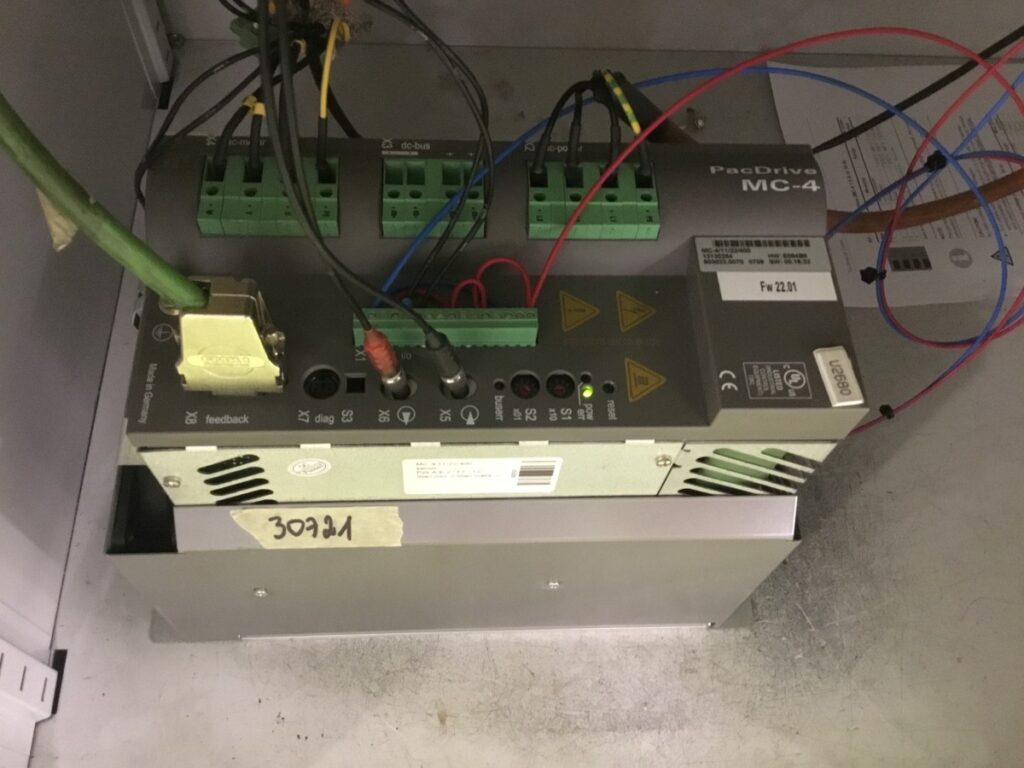
PacDrive MC-4 Servo Drive Repair and Functional Testing with an ELAU Servomotor
When a servo drive arrives for repair, restoring the electronic circuit is only part of the job.
The real question comes afterwards:
Does the repaired drive correctly control a servo motor again?
This was the final verification stage of a recent ELAU PacDrive MC-4/11/22/400 repair at Servo Motors Adjust.

The unit: ELAU PacDrive MC-4
The unit repaired in this case was:
- Model: PacDrive MC-4/11/22/400
- Part number: VDM01D22A000
- Drive family: PacDrive MC-4
- Manufacturer platform: ELAU
These references are directly visible on the nameplate of the repaired unit.

The PacDrive MC-4 is more than a simple power stage. According to its operating documentation, the system integrates the mains supply, power output stage and software regulator for one axis into the drive.
That is important from a repair perspective.
A repaired electronic board can pass individual electrical checks while a complete drive may still present a problem when controlling a motor.
For that reason, our repair process does not finish when the faulty electronic component has been identified and repaired.
Functional validation is the next step.
From electronic repair to functional validation
Depending on the original failure, a defective servo drive cannot always be fully operated when it first arrives at the workshop.
Therefore, there may be no meaningful “before repair” operating condition that can simply be compared with the repaired unit.
Instead, after the fault has been located and the repair completed, the drive must be tested as a functioning servo system.
For this PacDrive MC-4, we connected the repaired drive to an ELAU servo motor on our test setup.
This allowed us to go beyond a basic power-up test.
Why test the drive with a real servo motor?
Seeing LEDs illuminate or powering the drive without a motor does not demonstrate that the complete servo control chain is functioning correctly.
A servo drive works together with the motor and its feedback system.
For that reason, connecting a compatible ELAU servo motor allows the repaired drive to be evaluated in a configuration much closer to its actual operating principle.
In our test setup, the repaired MC-4 was connected to the motor, feedback and control system.
The test screen shown in this case identifies the connected motor as:
SM10040050P145M1B1
and displays the PacDrive status:
“No Error pending.”
This is much more meaningful than simply confirming that the drive powers up.


What are we looking for during the test?
The objective of functional testing is to verify the complete interaction between the repaired drive and the servo motor.
Depending on the specific drive and repair, the validation process can include checks related to:
- correct drive start-up
- communication with the control system
- motor feedback recognition
- motor enable
- controlled motor movement
- speed response
- direction of rotation
- behaviour at different commanded operating conditions
- monitoring of alarms and diagnostic messages
- stability of the drive during the test
The exact tests should always be adapted to the original failure and to the functions affected by the repair.
That last point is important.
We do not believe that every repaired drive should simply receive the same generic test. The validation should be related to what was repaired and what needs to be demonstrated
Powering up is not the same as being validated
This distinction is central to our approach to servo drive repair.
A drive that powers up has passed an important first step.
A drive that communicates, recognizes the motor feedback and successfully controls a compatible servo motor under closed-loop operation provides a much stronger level of functional verification.
That does not mean that a workshop test reproduces every possible condition of the customer’s machine.
It means that the repaired drive has been tested as part of a functioning servo system rather than only as an isolated electronic device.
And for us, that difference matters.
Why closed-loop testing matters after a servo drive repair
Servo systems depend on several elements working together:
Controller → Servo drive → Power stage → Servo motor → Feedback → Servo drive
A problem anywhere in this chain can prevent correct operation.
This is why functional testing after electronic repair provides information that static measurements alone cannot provide.
The electronics may be repaired correctly, but the real objective is to restore the function for which the equipment was designed:
controlled motion.
Repair. Test. Validate.
At Servo Motors Adjust, we work on both sides of the servo system: motors and electronic drives.
That combination is especially useful when validating repaired equipment because a servo drive can be tested together with the component it ultimately needs to control.
In this PacDrive MC-4 case, the repair did not finish when the electronic fault was corrected.
It finished with the repaired drive connected to an ELAU servo motor and functionally tested as a servo system.
Because in industrial servo repair:
Repairing restores the electronics.
Testing verifies the function.
Validation gives confidence before the equipment returns to the machine.


