The ELAU SM100 Case That Revealed the Difference Between Repairing a Failure and Restoring Reliability.

The reported problem was an encoder failure.
At first glance, this might appear to be a simple feedback-related issue. However, as often happens in industrial maintenance, the deeper we looked, the more questions emerged.
The most important question was not:
“Why did the encoder fail?”
It was:
“Was the motor ever fully validated after the previous repair?”


The First Warning Sign: The Controller Could Not Identify the Motor
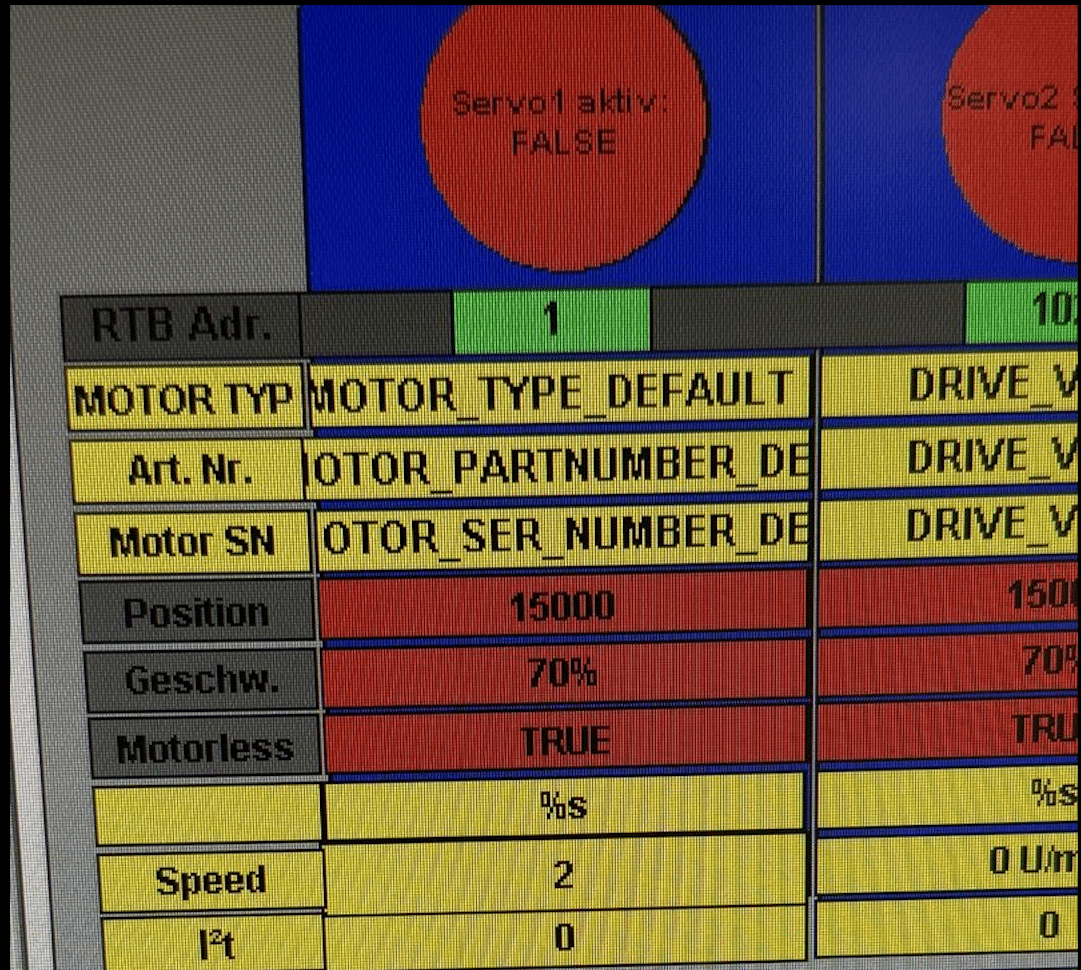
During testing on a Schneider Electric PacDrive MC-4 system, we immediately noticed something unusual.
The controller displayed:
- MOTOR_TYPE_DEFAULT
- MOTOR_PARTNUMBER_DEFAULT
- MOTOR_SER_NUMBER_DEFAULT
These parameters are normally stored within the motor’s feedback system and allow the drive to identify the motor correctly.
Without this information, the controller loses part of the motor’s electronic identity.
Several technical explanations are possible:
- The encoder may have been replaced without transferring the original EEPROM data.
- A compatible feedback device may have been installed without the manufacturer’s identification data.
- The memory within the feedback system may have become corrupted.
The exact cause was less important than the consequence.
The drive no longer recognized the motor as the original machine component.
For us, that immediately raised another question:
Had this servo motor actually been tested on a PacDrive controller before it was returned to service?
Because a complete functional test would likely have revealed this issue immediately.

The Encoder Was Not the Only Concern
As the inspection continued, additional findings appeared.
Evidence of previous intervention could be seen on the connector board. Several solder joints on the power connections showed signs of earlier repair work and a level of workmanship that deserved closer evaluation.
The purpose of this observation is not to criticize a previous repair.
The purpose is to highlight a reality that maintenance professionals face every day:
Reliability is rarely determined by a single component.
It is determined by the quality of the entire repair process.

A Hidden Mechanical Issue: Rotor Unbalance
One of the most significant discoveries emerged during rotor inspection and balancing.
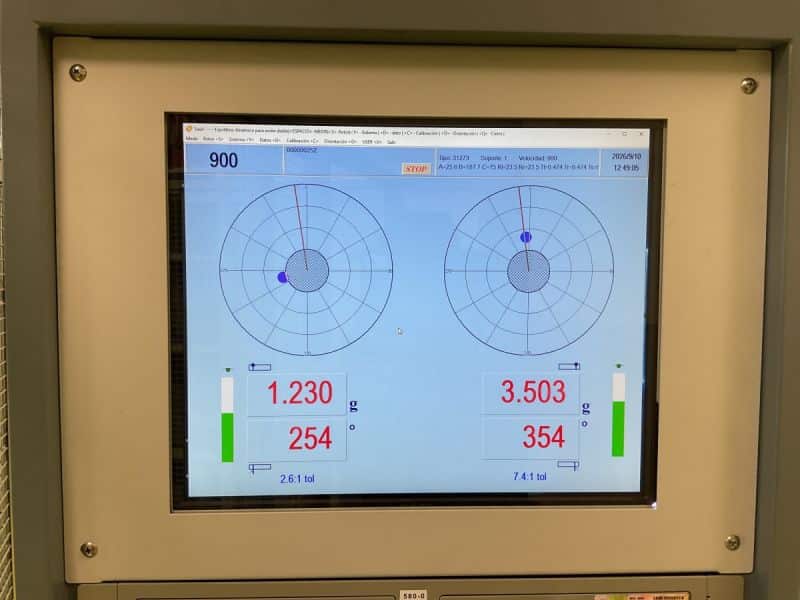
The rotor showed levels of residual unbalance that were considerably above what would normally be expected for a precision servo application.
– Initial balancing condition
| Plane | Residual Unbalance |
|---|---|
| A | 1.230 g |
| B | 3.503 g |

After dynamic balancing:
– Corrected condition
| Plane | Residual Unbalance |
|---|---|
| A | 0.044 g |
| B | 0.087 g |

The improvement was substantial.
More importantly, it removed a potential source of vibration capable of affecting overall system reliability.
Can Rotor Unbalance Affect Encoder Performance?
Most maintenance teams associate rotor unbalance with vibration, noise and bearing wear.
Those consequences are well known.
Less often discussed is the effect that excessive vibration can have on servo system performance.
High vibration levels may contribute to:
- Increased dynamic loading of bearings
- Premature mechanical fatigue
- Reduced positioning stability
- Greater sensitivity to feedback-related disturbances
- Reduced long-term reliability
In high-resolution motion control applications, mechanical problems and feedback problems are not always completely independent of each other.
Sometimes the symptom appears electronic while part of the root cause is mechanical.
That is why successful troubleshooting requires looking at the complete system, not just the reported failure.

A Servo Motor Repair Is Not Complete Until It Has Been Validated
Replacing a component is a repair activity.
Validation is what confirms the repair has actually solved the problem.
After corrective actions were completed, the motor underwent a complete verification process including:
Mechanical Validation
- Rotor dynamically balanced
- Bearing system inspected and renewed
- Mechanical tolerances verified
Electrical Validation
- Stator surge test completed
- Electrical integrity verified
- Phase condition checked
Feedback System Validation
- Encoder operation verified
- Motor identity restored
- Controller communication confirmed
Functional Validation
- PacDrive controller correctly recognizes the motor
- Motor type identified correctly
- Part number identified correctly
- Serial number identified correctly
- Functional run tests completed
- Post-repair vibration measurements performed
Only after all these checks can a servo motor be considered ready to return to production.
Why Rotor Dynamic Balancing Matters in Servomotors
Rotor balancing is often associated solely with vibration reduction.
In reality, it affects the entire reliability chain.
An unbalanced rotor generates centrifugal forces that increase rapidly with speed.
The consequences can include:
- Elevated vibration levels
- Increased bearing loads
- Reduced bearing life
- Higher operating temperatures
- Increased noise
- Mechanical fatigue
- Reduced service life
For conventional industrial motors, these effects are already important.
For servomotors, they can be even more critical.
Servo systems operate with extremely precise positioning requirements.
Even relatively small mechanical disturbances can influence the overall performance of the machine.
The Real Difference Between a Repair and a Reliable Repair
This ELAU servomotor is a good example of a problem we encounter regularly in industrial environments.
A motor can:
- Be repaired
- Pass a basic functional test
- Run successfully
- Return to production
And still contain hidden issues that compromise future reliability.
True repair quality requires more than replacing damaged parts.
It requires verification of:
- Mechanical condition
- Rotor balance
- Bearing condition
- Electrical integrity
- Encoder functionality
- Drive compatibility
- Overall system performance
The objective should never be simply to restore operation.
The objective should be to eliminate the factors that caused the failure in the first place.
Conclusion: Reliability Begins with Validation
The lesson from this ELAU servomotor is simple.
A repair is finished when the motor has been thoroughly validated and proven capable of operating within its original specifications.
That includes mechanical condition, electrical integrity, feedback system performance, vibration levels and controller compatibility.
Only then can a motor return to production with confidence.
Because in servo applications, reliability is built on verification, not assumptions.





