Servo Motor Condition Monitoring: Detecting Bearing Degradation Before Failure
- A real case showing how wireless vibration monitoring, spectral analysis and failure-pattern recognition identified a developing servo motor bearing problem while the motor was still operating.
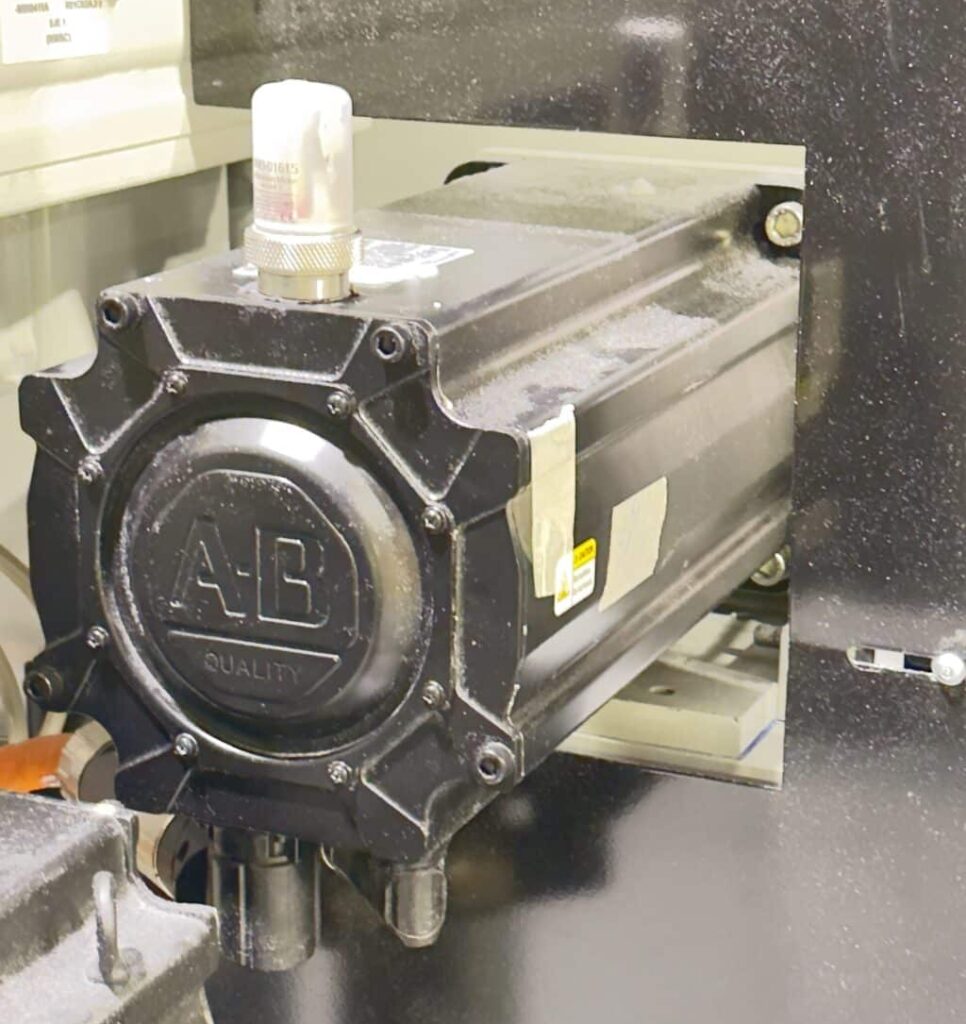
The servomotor was still running.
It had not stopped production. It had not yet been removed from the machine. And it had not arrived at our repair workshop.
But the vibration data was already telling us that something was wrong.
Normally, the process starts when the problem becomes evident:
Failure → Machine stop → Motor removal → Diagnosis → Repair
This real case shows how condition monitoring, vibration analysis and failure-pattern recognition allowed us to identify a developing bearing problem while the servomotor was still operating.
More importantly, once the motor arrived at Servo Motors Adjust and was dismantled, the physical inspection confirmed what we had already identified from the vibration data.

Monitoring the Servo motor While It Is Still Running
Wireless vibration monitoring makes it possible to collect condition data from the machine without waiting for the motor to fail.
But the sensor itself is only the beginning.
The real value lies in understanding what the data is telling us.
Instead of relying only on an overall vibration value, the analysis can include:
- Velocity spectrum
- Acceleration FFT
- Envelope FFT
- Time Waveform
- Rotational speed and harmonics
- Bearing kinematic frequencies
- Modulation and sidebands
- Behaviour under different operating conditions
- Previously identified failure signatures
In this case, vibration measurements were obtained at several operating speeds, including approximately 635, 755, 880, 1,040 and 1,290 rpm. This allowed us to study how the vibration signature evolved with rotational speed instead of relying on a single measurement.
The important question was no longer simply:
Is the motor vibrating too much?
It became:
What is the vibration signature telling us about what is happening inside the servo motor?

From Vibration Levels to a Failure Mechanism
This distinction is fundamental.
An increase in vibration can tell us that the mechanical condition is changing.
A characteristic vibration pattern can help us investigate why it is changing.
The diagnostic evidence pointed towards bearing instability, increased internal clearance and probable cage degradation.
At approximately 755 rpm, the rotational frequency was around 12.58 Hz.
For the rear 6206 bearing, the calculated Fundamental Train Frequency, or FTF, was approximately 5.01 Hz. The measured value was approximately 5.05 Hz, showing very close correlation between the theoretical bearing kinematics and the measured vibration data.
The diagnosis was therefore not based on one isolated spectral peak.
It was the correlation between several independent pieces of evidence that increased confidence in the diagnosis.

The Servo motor Was Still Running, but the Failure Pattern Was Already Visible
This is where condition monitoring becomes genuinely valuable.
The objective is not simply to detect when a motor has become unusable.
The objective is to identify a developing condition early enough to make a controlled maintenance decision.
This meant that before dismantling the servomotor, we already had a technically supported diagnosis of the likely problem and knew where to focus the subsequent inspection.
Before the motor reached our workshop, we already knew where to look.
From Predictive Diagnosis to Physical Evidence
This is probably the most important part of the case.
A diagnostic hypothesis becomes considerably more valuable when it can subsequently be compared with physical evidence.
Following the vibration analysis performed while the motor was operating, the servomotor was removed from service and sent to Servo Motors Adjust.
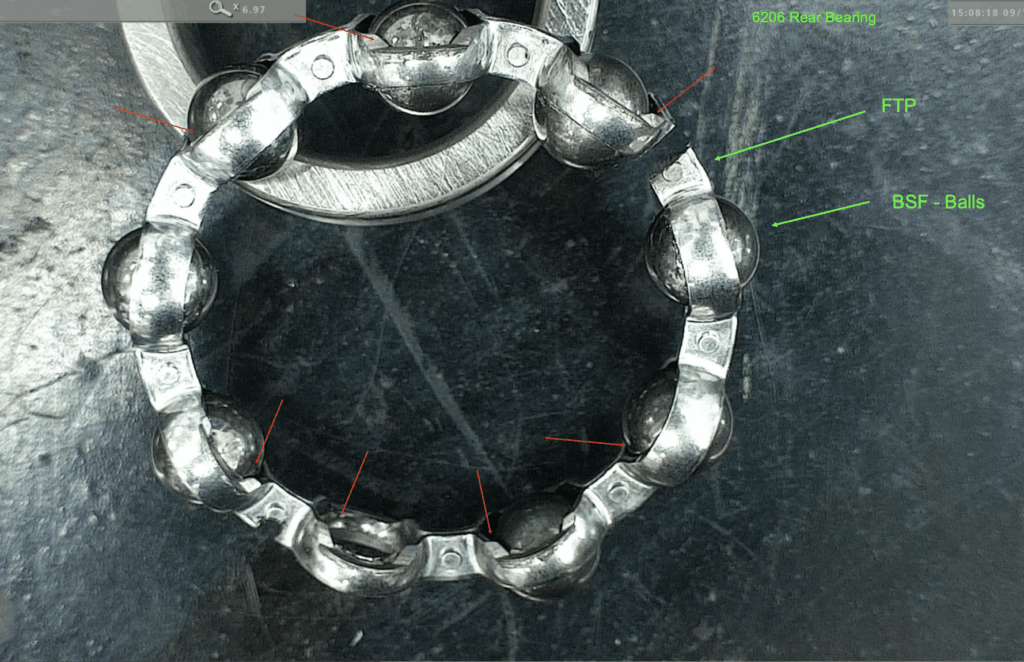
The motor was dismantled and the rear 6206 bearing was inspected.
The physical condition was consistent with what had previously been observed in the vibration data.
Inspection confirmed severe cage deterioration in the rear bearing, correlating with the vibration symptoms identified before disassembly.
This closed an extremely important diagnostic loop:
Vibration signature → Diagnosis → Disassembly → Physical confirmation
The bearing problem identified while the servomotor was still operating was subsequently confirmed during physical inspection.
We did not have to wait for catastrophic failure to begin understanding what was happening inside the motor.


Why Physical Confirmation Matters for Machine Learning
This is where machine learning becomes particularly interesting for us.
Predictive maintenance should not simply mean an algorithm generating an alarm when vibration exceeds a predefined threshold.
The greater opportunity is failure-pattern recognition based on validated real cases.
Consider the complete information chain:
Motor operating
↓
Wireless vibration monitoring
↓
FFT / Envelope FFT / Time Waveform
↓
Failure signature identified
↓
Diagnostic hypothesis
↓
Motor dismantled
↓
Physical damage identified
↓
Diagnosis confirmed
↓
Validated failure pattern
Every monitored motor that is subsequently inspected gives us an opportunity to connect two different sources of information:
What the failure looked like in the vibration data
and
what was physically damaged inside the motor.
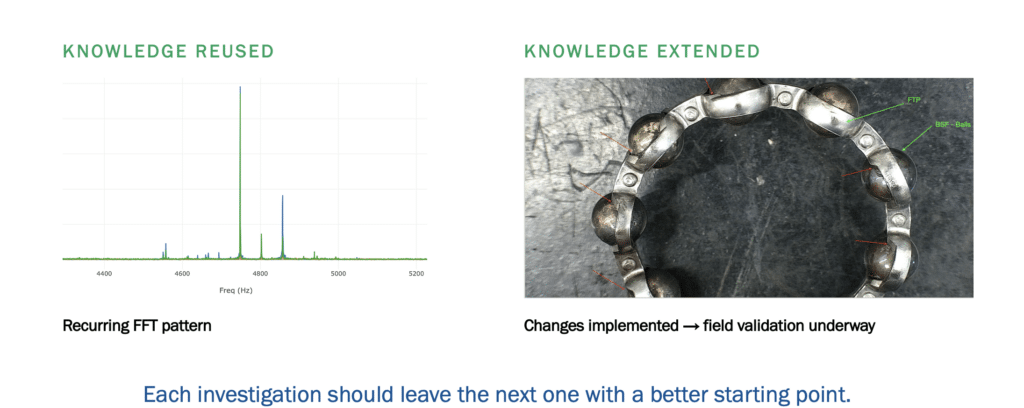
That relationship creates reusable diagnostic knowledge.

Every Confirmed Failure Adds Knowledge for the Next Diagnosis
Imagine that a specific combination appears repeatedly:
- characteristic bearing frequencies,
- impulsive activity,
- particular sideband structures,
- rotational modulation,
- amplitude changes,
- characteristic waveform behaviour.
If motors displaying these signatures are subsequently dismantled and similar physical damage is repeatedly confirmed, those patterns become increasingly valuable.
We are no longer looking only at whether a vibration level is high or low.
We are building a relationship between vibration signatures and physically confirmed failure mechanisms.
This is where Machine Learning can add significant value.
New condition-monitoring data can be compared with previously validated failure patterns, helping engineers identify similarities between a motor currently operating in the field and motors whose actual failure mechanisms are already known.
The objective is not to replace engineering judgement.
The objective is to make previous failure knowledge reusable.
Every confirmed failure can therefore help us interpret the next one.

Knowing What to Look for Before the Motor Arrives
Traditionally, the diagnosis of a servomotor starts when the motor arrives at the repair workshop.
Condition monitoring creates another possibility.
It allows the diagnostic process to begin while the servo motor is still operating at the customer’s facility.
When a developing vibration pattern is detected, we can investigate:
- the suspected failure mechanism,
- the severity of the condition,
- the progression of the vibration signature,
- the recommended maintenance action,
- and the components that should receive particular attention during inspection.
Potentially, by the time the servomotor arrives at Servo Motors Adjust, we already have valuable information about its condition.
For maintenance teams, this can also change the decision from an unexpected production problem into a planned maintenance intervention.

Repair Is Not the End of the Process
There is another important advantage.
When vibration data exists before the repair, comparable measurements can be used afterwards.
We can then ask a very simple question:
Did the repair actually eliminate the mechanical signatures that were present before?
In the documented case, the dominant rotational vibration component was approximately 2.78 mm/s before corrective intervention and approximately 0.12 mm/s afterwards. Final balancing measurements also confirmed that the rotor met the specified ISO 21940 G2.5 balance quality requirements.
The post-repair measurements therefore provide another important layer of evidence.
The objective is not simply:
Repair the motor.
It becomes:
Diagnose → Repair → Measure → Validate.


From Reactive Repair to Predictive Servo Motor Maintenance
The traditional process is essentially reactive:
Failure → Production stop → Motor removal → Diagnosis → Repair → Return to service
A condition-based approach changes the sequence:
Monitor → Detect → Diagnose → Plan → Repair → Validate → Learn
That difference is important.
Instead of asking only:
What happened to this motor?
we can increasingly ask:
What is beginning to happen inside this motor, and can we intervene before it leads to a breakdown?
Can We Predict Every Servo Motor Failure?
No.
And we believe this distinction is important.
Not every servo motor failure can be predicted with 100% certainty from vibration data alone.
Different failure mechanisms generate different signatures, and diagnostic confidence depends on factors including operating conditions, speed, load, sensor location, measurement quality and the availability of validated historical cases.
Machine Learning does not remove these engineering limitations.
But it can help us identify patterns, correlate new data with previous cases and make accumulated failure knowledge easier to reuse.
What makes this particular case significant is much more concrete:
A developing bearing problem was identified while the servo motor was still operating, and the diagnosis was subsequently confirmed through physical inspection after disassembly.
That is not a prediction about what technology might be able to do in the future.
It is evidence from a real case.
The Future of Servo Motor Repair Can Start Before the Motor Reaches the Workshop
Servo motor repair will always require mechanical expertise, measurement, inspection and functional testing.
But the diagnostic process does not necessarily have to start when the motor arrives at the workshop.
Wireless condition monitoring provides the data.
Vibration analysis helps us understand the mechanical behaviour.
Failure-pattern recognition connects new signals with previous experience.
Machine Learning can help us scale that accumulated knowledge.
Physical inspection provides the evidence needed to confirm or correct the diagnosis.
And post-repair measurements allow us to verify whether the original mechanical signatures have actually been eliminated.
Together, these elements create a continuous process:
Monitor. Detect. Diagnose. Repair. Validate. Learn.
And every completed cycle gives us something valuable:
more knowledge for the next servomotor.
At Servo Motors Adjust, our objective is not simply to repair a servo motor after failure.
Our objective is to understand the problem as early as possible, repair based on evidence, validate the result and retain that knowledge for the future.
Is Your Servomotor Showing a Change in Mechanical Condition?


